
Pay Per Callers Show · I host this one
Beyond Revenue, with Manny Zuccarelli
This one's my show, and my guest was the first person to ever earn our $100 million GOAT Award. Manny and I told the unglamorous truth about building real companies: the years of losses, the panic attacks, the marriages it cost, and the servant leadership that got us both through.
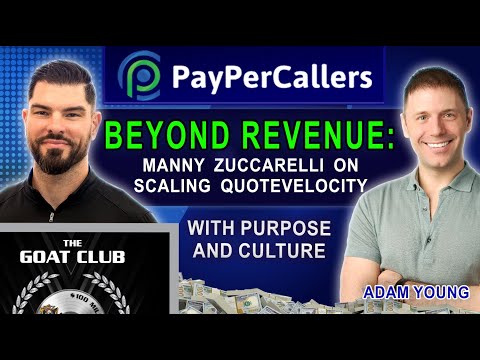 Watch on YouTube
▶ Play the episode
Watch on YouTube
▶ Play the episode
What's inside
- No founder paycheck at Ringba until 2021, and I'm still not the highest paid
- The 2 a.m. Sunday support call I took myself
- The $80,000 overcharge nobody would have caught, refunded immediately
- Turning the dark years into fuel, on both sides of the table
“You're successful because you behave this way, not you behave this way because you are successful.”
me, to Manny
Every word, searchable
The Full Transcript
Read the full transcript
Transcript lightly edited for clarity.
Announcer 00:00:00
Welcome to the Pay Per Caller Show, brought to you by Ringba.
Adam Young 00:00:09
Hey everybody. Welcome to another episode of the Pay Per Caller Show. I am super excited about this conversation we're about to have in the studio today with me is my good friend and customer, Manny Elli, the first recipient of a hundred million dollars Goat Award, and we're going to walk through how he built his business, the lessons he learned while doing it, and other important things in life. And so thank you so much for coming to the RBA Mastermind house today. I'm super excited to have you here.
Manny Zuccarelli 00:00:39
Thank you, brother. Thank you for having me.
Adam Young 00:00:41
Yeah,
Manny Zuccarelli 00:00:42
Thank
You. Thank you.
I know that you've been trying to make this happen for a while.
Adam Young 00:00:45
Yeah, well, what's crazy about our journeys is where we met at Leeds Con a long time ago. You were like a team of one or two, and I think Ringba had five people at the time, including me and Harrison. And so we were just at the beginning of our journeys. And then over the last 5, 6, 7 years, we've built much bigger organizations. We've talked a lot over the years. I'm just really appreciative of our relationship because I know how important personal growth is to you and leadership is to you. And I think, yeah, it's where it starts and I think our organizations are really aligned in that way. And it's just been so cool to watch your growth and success over the years and it's very humbling to have played a part in that
Manny Zuccarelli 00:01:38
Large part in that. Yes,
Adam Young 00:01:39
Thank you. So I'm very honored to have this conversation today. And so where I'd like to start is where did Velocity come from? What was the genesis? How did you get started? What got you into the industry? Let's just go all the way back.
Manny Zuccarelli 00:01:59
I was mean really been in affiliate marketing since 14, 15 years old when the a OL days were around
After having built and grown various companies in the performance marketing space. I think I just reached a point where I was no longer aligned with the direction that the company that I was running was going in. I wanted to build a company where I could really have sort of an enterprise level organization where I could bring in a great team that where you build real careers and create some sort of impact that was beyond just running traffic and running offers and building a network. And I felt like we were too cookie cutter for what we were doing. Although the engineering team, my partner, everybody, I mean these guys were the best at what they did. But I think I just reached a point where I sort of evolved a little bit past it. And it's nothing to say that I didn't enjoy what we were doing. I wanted more out of life and I was in a period where honestly, I was in transition. I was actually, what's funny is as I was thinking of building quote velocity, I was thinking of building a nutritional company at the very same time. So I got various nutrition certs and I'd had always been a passion of mine still is.
And I started QV and we got started. We got started in the finance space. It was myself and a good friend of mine and it was tough, man. I think I underestimated the shift from what I was doing to this. I was not one of those companies that just took off right away and just hit the ground running with profits. We lost money for maybe eight, nine months. Looking back on it. I think I was trying so hard to just figure out what I needed to do to now evolve into what was now a call space. Whereas years prior, everything was really leads and data and I was forming all new connections, all new relationships. It was a completely different company. Yes, it was still marketing, but it really served a completely different purpose. And we were a company out of South Florida. So to pierce through the negative reputation that exists in this area for lead generation in general,
And then to develop a reputation as somebody who was doing the right thing, it made me go overboard with compliance and overboard with how we ran the business, which later really mattered. And that's hard to do in the early stages of a company where all you're trying to do is survive, right? We were, it wasn't like I had capital from outside investors and although I had done okay in the past, it was still, it was just foreign to me. I had to learn everything. I had to learn technology, I had to understand what vertical I was going to get into and why and how do I master this and who am I competing against and what are the laws that govern this ecosystem? And I feel like it took me longer than I would've hoped for to get going. Looking back on it, what I really wish I would've done is I wish I would've embraced that pain a little bit more instead of allowing it to kind of shock and jar me
Into
A shit. Was this a good decision? Should I just go back to what I was doing? Can I go back to what I was doing, which I think is something we should talk about later and how that can totally fuck with your mental framework.
Adam Young 00:06:06
Well, I think what you said there was interesting was you came from sort of a DR space performance space and had expected that you were going to see immediate results.
And
I want you to know you're not alone. Ringo lost money for not eight months, but years. And that was by choice. We had revenue. We just wanted to keep growing the team and keep improving the product and have always invested in that we considered an investment. But to your point, I also did not anticipate that we would not be an overnight massive success that was throwing off a ton of money. And maybe that was my roots, like you of being in performance marketing where listen, I'm going to crack the campaign, I'm going to light it up and it's going to be great. But building a real business is a marathon, not a sprint. And so I'd like to ask you, when you were going through that eight month period of just losing money, how did you think about that and what was your mindset where you knew, Hey, I'm going to figure this out. I'm committed to it even though every single day I'm losing money, which is painful. How did you balance your mindset while going through that
Manny Zuccarelli 00:07:22
Reading books that were related to this topic? So Ben Horowitz is the hard thing about hard things. Great book I feel like in some ways saved me having the right mentors. And I don't even mean in close proximity, I just mean at a distance having great mentors. Andy Ferel and others who had the M-F-C-E-O podcast at the time was really growing as I was in these early stages of velocity and listening to that every single day on the way to the office, sometimes in the middle of the day if I felt like I needed it on my way home. I mean, I owe everything to that podcast, to that man for the content that he put out, praying every day, every day. I know people have different opinions about religion and whatnot, and I'm not here to, but I do think that asking God or the universe or whatever sort of suits you best for guidance and for help, it gives you the understanding that there is hopefully someone something out there that can help influence you in the right direction. I prayed every morning. I begged some mornings. My wife was very supportive through the beginning and gave me the confidence to keep things going. My brother, my friends, I have a great support system. So it wasn't that I went looking for empathy, but it was definitely like they saw it affecting me.
You could see it. And I'm pretty extroverted, so it's not that hard to,
You
Can read me pretty well. Everybody kind of said, look, just keep moving along. What I will say is, and I feel like I now do this a lot to pay it forward. If you are working with someone who's in the early stages of their business or you are, even if it's not a friend, but just an associate, someone you communicate with, when you're in those early days and you're really like, I don't know that this is going to work, and all of that anxiety starts to hit you, you'll take any small win and it can take you through the whole week. So I remember people in the space when I first got started saying, I've seen people just like you build great companies. Someone said that to me at one point, and it was right at the time where I was losing money and I was again, almost a year in and I'm like, man, I just feel fucking stupid. I don't know why I can't, what I'm really having trouble with here. But that comment carried me for a week
And it helped me get through that period at that time where, and then I'd have another small win that later and another small, and it could have meant nothing. It could have been somebody's email response that was just positive in nature, and it just helped me make it a little bit further so I didn't just dump this and go back to what I was doing. And to this day, I try to pay that forward. I know you and I were talking about it before, especially when people reach out to me like, Hey, I saw you on your first podcast with Adam and I stop, and I do try to help them. I've talked, and I don't want to say who, and maybe they'll announce this at some point on your podcast, but I've talked several people off the cliff and into remaining in their business or starting a business. So leaving where they are and starting a business in this space competitors. And to me that's just a way to pay it forward. And I think I was very fortunate to have the support system that I have in place and be that from my friends, my family associates. Again, God, whatever that looks like, it helped me and I'm forever grateful for it.
Adam Young 00:11:18
Well, on the praying side, David Sto and I just had a conversation about this and it was about defining and manifesting what you want in life. And I talked about how I went through a really traumatic period about a year ago now and sort of how I managed through that situation. And I think if you simply remove the religion from the practice, what we're really talking about here is defining, Hey, I want to achieve this. This is who I want to be. This is what I want to accomplish. And by praying or writing it out or journaling or whatever the vehicle is of defining those things and then sending it out to the universe. I called it cheat codes for life. And my preferred method is journaling, and I've used it extensively.
Manny Zuccarelli 00:12:18
Have you looked back on those journals? I journaled every day for almost three years.
Adam Young 00:12:23
I did actually. Yeah. So I was trying to talk about how my life has progressed with my girlfriend actually, and I got back into my live journal account from 2001. Wow. And reread the whole thing and read it with her. And I remember those times, they were not good times in my life. They were really bad times in my life. But by writing it down and thinking about how I felt and what I wanted to do, you could even see in the progression over the year, I used it for a year that I had completely changed my situation because I was just thinking about how do I change this? What do I want it to be? And writing and being vulnerable with myself about how I felt about it and who I was and what I wasn't good at and what I didn't like about myself that I wanted to work on. And I think prayer is very similar to that practice. Absolutely. And it's really an effective way to just sort of put that out there. And I think whatever you're focused on is what you're going to see results in if you don't give up. And so I really like that you went through that practice. And I do think it's cheat codes for life. The only people who don't succeed in business are the ones that stop trying, the ones that give up. If you eventually, Michelle, you may have a couple of businesses hub
Manny Zuccarelli 00:13:55
Fail, they think they can't fail.
Adam Young 00:13:58
But even then if they fail and then they start again, I think the people who really truly fail and go back to some other way of life, just give up and stop learning. Well, that's really incredible. And I think the story is very reminiscent of a lot of entrepreneurs. Same thing. I literally had a panic attack in 2017 because I felt like I wasn't delivering the results I needed to deliver for the people I had committed to. And it was a really hard day for me. I had to accept that I was failing at certain things and in life and business, and I didn't like it. I didn't like the feelings. Obviously none of us do. And I just laid there for a while and was just like, fuck, I am just going to need to work much harder.
Manny Zuccarelli 00:14:54
And I don't know that everybody understands that because I think everyone tries to act like there's some sort of oracle or demigod, so you end up missing. So if you're somebody who's starting off in some space, you end up missing that early period of what these people went through. And so all you see is them having figured everything out or they act like they figured everything out. I got newsfeed, which camera can I look at here? This one,
Adam Young 00:15:18
You can look at anyone you want.
Manny Zuccarelli 00:15:19
Nobody has anything figured out. We're all learning constantly.
And especially in the early days, you feel like you're almost an imposter. I guess there's a word for imposter syndrome, right? And it's a very real thing and you're trying to kind of drive this machine out of, but what I think people don't really begin to appreciate is that you're sitting there, you're working till late at night and nobody sees it, and you're sending emails at 10 o'clock and nobody sees it and you're working on the weekends and nobody sees it except for maybe your family. And it's like a rocket ship trying to take off. You've got all this noise and all this activity going on, and this thing's just not even moving. And then it's like it kind of gradually starts to come up and it begins to push past the gravity that's trying to pull it down, and then it catches momentum, and then it's like you can't fucking stop this thing. And so I think people should try to look at the early days of their business as that ship, just trying to take its first steps towards reaching escape velocity, no pun intended.
Adam Young 00:16:41
No, I think that's a great example. And I think a lot of mean, our story is very similar and people definitely speak to me differently today than they did back then. But in reality, I think the panic attack, the losing the money, the losing money and the stress and all that, that's the most important part of the process. And when people see it from the outside or they see success from the outside, they don't see the 10 years of struggle prior. They just see the end result. And it's really hard to communicate to people what it actually takes and what you have to go through to do it. I think the journey is a hundred percent worth it. I would never do anything else. Even if I had to start all over today, like entrepreneur all the way through, I'll suffer again. And it is this beautiful journey. But when you see success, the real questions and the things people should be focused on if they want to learn how to achieve that success is what was the pain in the suffering at the beginning? What were the problems you solved and what was it like to scramble through without resources or whatever it is? Because that's where the real lessons are taught. That's where I learned everything. I got a monthly p and l, now I'm not learning anything from it. I have to seek out the lessons. I want to learn to do it.
Manny Zuccarelli 00:18:10
And I also think it's important to not forget what that period felt like so you don't end up back there again. So this is kind of what I was saying to you before about I consciously and actively think on a, I wouldn't say an hourly basis, but surely on a daily basis, this team could just walk out on me. If I don't perform, this is all rented in some way, I have to still show up
And you want to talk about the pain that would bring about or probably even worse than what the beginning of your journey felt like. So yeah, I cannot stress that enough. I mean, it makes me sick to see people build organizations or start a company and they finally push through the infancy stage and they begin to act like teenagers. And that's when most companies really fall is you lose no longer have the humility or you don't remember the pain that you felt. And you're now taking it all for granted, your people, your clients, just the whole thing, right? You've turned into a teenager quite literally. And from what I've seen in our space, and even just in other industries and friends, that usually is where you see people begin to fall apart.
Adam Young 00:19:42
And I don't know if this was different for you, but I think the root cause of that, or maybe not the root cause, but one of the roadblocks there is that once you start to scale and find that success, you have to, you're no longer competing externally. You're competing internally. You now have to constantly try and improve yourself and your leadership skills and do all those things. And so it's a very different challenge than how do I start this business and make some money now It's like I am responsible for people, I'm responsible for customers. How do you develop the mental framework to serve them appropriately? And it's like this constant never ending evolution. And then as the business grows, you have to rebuild the whole thing. You have to constantly change what you're doing and improve things. And that in itself can be just as taxing or complicated as the original dealing with the pain. And so it's almost like they, they start to see some success. They turn into teenagers because they're like, for me to continue down this path, I have to revisit all of the effort in learning and start over.
Manny Zuccarelli 00:20:58
Basically.
Adam Young 00:21:02
For me, I mean, it's a perpetual challenge, but it's something that's important to me. I want to keep growing and doing that, but it takes an immense amount of effort and it's a very different,
Manny Zuccarelli 00:21:16
Very different, but I think it's just a business maturity thing. I think even what drives you early on when we're young, everybody just wants cool shit. That's what you just want. And I actually don't think there's anything wrong with that at all. I think that if you're inspired by things, that's fine. Early on, early on, I think that if you are human with any degree of personal development or just conscience, what'll end up happening is you'll realize that nobody's going to remember you for the car that you drove or the watch that you wore or whatever you bought. That shit just doesn't really matter. After a little bit, it's just noise. And then what starts to happen is you get the email. I just want to thank you for what you've built here.
I
Could take care of my family.
I'm not an academic. I didn't even finish college. I don't have any degrees. I have a wall full of messages that I've received from our team. And that is, and I think when somebody's starting a company and they hear this, they think it's like, all right, this is bullshit. This is what these guys say. Once things are kind of grooving, no, it's so much more rewarding. Actually. There's second and third order effects of what you're doing that actually matter. This is holy shit. There's now hundreds of people that we're taking care of and we're consistently thanked for. We pay more than almost any other, especially at the call center level, that for sure, and we take care of our team, we look out for their health, and we'll get into some of the fitness stuff in a bit, but you can't fake that. It has to be sincere.
Adam Young 00:23:14
But
Manny Zuccarelli 00:23:14
Then the gratitude that comes from, from the personal development that you talked about, which is crucial on that point, your business will not grow beyond your degree of personal development. And I don't know that people really appreciate that. I think they've read a few books or they watch some stuff and they're like, all right, I'm good. And now my business is okay, and now it's supporting my lifestyle and you're going to fail, whatever that is, it's not going to really last. There's no way for that to last with that kind of attitude. You have to almost that sort of productive paranoia of always feeling like, again, I have to keep showing up for my team. And the reward that you receive thereafter from those who've decided to join you and I say, decided to join you, you'll never hear me say, or really anybody on my team say, they work for us. She works for me. He works for me. I don't even know what the fuck that means. You're a team.
Adam Young 00:24:22
Exactly.
Manny Zuccarelli 00:24:22
And this person is there on your team and you're showing up for each other. I don't know if it's a, people just have to kind of evolve past that and begin to, I think look at their team with a higher degree of gratitude and understand this person could go other places and they've chosen to, if you're leading the organization, they've chosen to see your vision in some way, shape or form and believe in you. And that's not something that you can ever take for granted or feel as though you've sort of settled. That has to be a constant reminder. And so yeah, I think people have a high degree of humility in the beginning. They're scared. They begin to kind of see some success or some activity. They become hubris kicks in, and they start to think they got everything figured out. And then at some point, someone who has deeper desires and more motivation kicks 'em right in the teeth, and I think it's well deserved.
Adam Young 00:25:29
Yeah.
Manny Zuccarelli 00:25:30
So yeah, I think I've done at least a somewhat okay job of consistently reminding myself through various means every day, be grateful for what you have. You can lose this all tomorrow.
Adam Young 00:25:46
Yeah. Well, I mean you put that into practice. Every time you and I communicate, you always say thank you. You always say, please, you always say you're grateful. And I think that type of practice is really, really important. I'm a big proponent of saying Thank you and please is free. I always say, please and thank you and try to express gratitude, but also not as a surface practice. I am actually,
Manny Zuccarelli 00:26:11
It's got to be genuine. It's
Adam Young 00:26:12
Got to be genuine, actually grateful. And I think the letters on your wall and this and that, when people look at it, you're like, oh, you're already successful so you can behave this way. The reality is you're successful because you behave this way, not you behave this way because you are successful,
And very similarly, you were just taking a photo of our goat wall in the kitchen, which is 105 1 million awards that we hung up on the wall. I have tons more piled over there. We're going to cover every wall in here and that because I want to be reminded of why we're doing what we're doing. Because if you have a mission that impacts others and you can help others, the real results that you receive are not the personal ones. It's like, wow, I got to help this person build something that now helps thousands of people or employs a ton of people or changes people's lives in some positive way. And whether anyone actually knows that this is an accomplishment or not is kind of irrelevant. That to me, keeps me fulfilled and very driven, understanding that, and then focused on the framework of customers team. I eat last, I
Manny Zuccarelli 00:27:33
Eat last.
Adam Young 00:27:34
Yeah,
Manny Zuccarelli 00:27:34
I eat last is something, man, when I hear people refer to their team as a cost, I think I had this conversation with you in Yeah, I mean all that really tells me is that you are just a shitty leader. And really to this day, I mean, I've paid myself significantly less than people probably would assume in an effort to continue growing the organization.
Adam Young 00:28:05
Harrison and I did not receive a paycheck at Ringo until 2021. We founded the company in 2015. We put up all the cash to grow it, and we have never given us ourselves a raise since 2021. And we make significantly less than most of our employees
Team members. And I don't even think that they really understand this, or maybe people don't believe it or whatever. A lot of what people see now they think is the success of Ringba, like, oh, hey, we're in this place or whatever. But Harrison and I did super well for a decade as business partners before, and we invested that money wisely. We acquired other businesses. In reality, we have essentially left Ringba alone so that it has a significant amount of growth capital so that our team members are taking care of that. Our runway is, our runway is forever. It doesn't matter. We need to hire 10 or 15 engineers right now that are really high level. That's $2 million a year in payroll.
And we've just been really conservative about that. And I don't think people will believe it if they see it, they see some of the things that we do. But I always say to Harrison, listen, we're going to be really conscious about this. If you want to do this activity, I'm down with it. But you need to figure out how do we do it at cost? How do we turn it into a business? How do we figure out a way to make it work so we can get what we want without just making a poor financial decision? And this is a type of sacrifice that doesn't really change. And I think what you were talking about earlier is entrepreneurs starts to see success and they have this shiny object syndrome. They're like, wow, I'm making some money, so I'm going to go buy all these things. I'm going to fulfill all those needs and desires. And what they're essentially doing is trading their future for
Manny Zuccarelli 00:30:18
Or for growth.
Adam Young 00:30:19
Yeah.
Manny Zuccarelli 00:30:20
Oh, absolutely. Yeah, a hundred percent. And I think, yeah, that coupled with the idea that this will never end, that coupled with the idea that I've got everything figured out, like, no, no, man. There's some kid in his basement on 40 milligrams of Adderall that's ready to cut your throat. How about that? Seriously? So I think realizing, and those are the guys that I'm afraid of. I'm not afraid of the ones that are out there that I could see. Those are the ones that I'm like, so
Adam Young 00:30:54
Because it was you
I mean, that was me. And I think that fear is valid, and I don't think you can ever stop being paranoid about it, right?
It's funny, we were looking at our CSAT scores, customer service scores, and we track everything and we look at ratings and feedback, and we have a whole apparatus now around this, and I see our feedback scores and they're phenomenal. And then I go, no, no, this is just not good enough. And the team's like, what? And I'm like, no, it's not you guys. It's not that you aren't good enough. You guys are amazing. We can't just look at this and go, alright, we're good. How can we improve it? Where do we take it to the next level? Okay, so 150 times we got it right, but one time we got it wrong. How do we make sure that never happens again? And I think that not resting on those laurels and never letting that go is super important if you want to continue to grow. Because that kid in the basement will essentially be like, all right, cool. Well, this part of their business isn't good. This part is I'm going to do X, Y, and Z and figure out a way to do it better. And maybe it doesn't eat the whole business away, but if you're not constantly improving, it will start to erode, erode progress.
Manny Zuccarelli 00:32:25
And you say if you want to continue to grow, and I think that's important. I do meet people frequently who are like, you can kind of see they're good where they are, and they've sort of lost that flame. I think a lot of that has to do with your community. If your goal in life is to impress your neighbor, you're probably going to end somewhere far lower than you're capable of. If you then go and join a community or you involve yourself in events or I'm a member of the RA syndicate, actually, I'll be out there in June in St. Louis, when you're surrounded by people that are at a point in their life where you're talking, they've made massive, massive impacts and waves in their industries and they're deep into nine and 10 figure businesses. They've seen past the sort of immature early stage drivers or motivators, if you will, which again is okay, whatever gets your ass
Adam Young 00:33:33
To that point.
Manny Zuccarelli 00:33:34
To that point is fine with me.
Adam Young 00:33:36
But you have to evolve.
Manny Zuccarelli 00:33:38
You have to evolve, man. And I think some people reach a point where they're like, look, I don't want to do this anymore. I want to be home with my family. And I think that's okay. But what you do have to realize is that if you're there mentally, your team is seeing it.
Don't ever think they don't see it. I mean, assuming you hired smart people, which I hope you did, they're going to see that and they're going to be like, this dude's checked out. He's here, but he's not here. And what'll happen is those that stay in an organization that are not great and are not going to give it their all because they're like, there's no future for me here and no one great is going to join that organization. This is kind of just, it's sort of just simmering, right? No. And so you'll lose great people, so eventually you'll fail anyway. So really what is the answer? And I think that depends on where you are in your life and what you really want. I want a legacy. I want something my kids can be proud of in the future. And whether they decide to take a similar path in some way, shape or form, what I do want them to see is that their father did all that he could with the time that he was here. And the contrary to that is that it's cost me a lot. It's cost me a lot with my family. It's cost me a lot in my marriage. It's been tough. And so at the conference we just had, when I gave that talk, what I was really trying to express was, and this is why I advocate people starting businesses really young, do it when you're young and you don't have a family and kids, but if you do, I mean all the more you have to power through it is when you're that focused on something, everything else becomes a blur
Because I mean, I'm talking it was 15 hours a day, seven days a week, maybe 12 some days and maybe 10 on a Sunday if I was lucky for a long time. And the people that matter to you, they're there for you and they're going to ride for you. But your absence is felt. And if you're at a point where you're starting a business and you have a family or you have a man or a woman who you're with, making conscious time to be there for that person or for those people that matter to you is really crucial. It's something I wish I would've done a better job of. You don't want to try to pick up the pieces later and put this thing back together
Adam Young 00:37:08
Trying to put a broken base back together.
Manny Zuccarelli 00:37:11
And those cracks are main, maybe it's whole again, but does it have the integrity that it did when it was first built, right?
Adam Young 00:37:26
Business cost me my marriage a year ago,
Manny Zuccarelli 00:37:31
And if somebody were to ask you, and this could seem, I really don't care,
Adam Young 00:37:37
Go.
Manny Zuccarelli 00:37:37
But if somebody were to say, would you do it again? Your answer would be, I don't have to ask you. Your answer would be yes. And I thought about this a lot and I was like, what I'm ultimately looking for is that the result of the activity that I influence result in greater, again, second and third order effects later. How many people put food on their table? How many lives did we positively influence? And I'm regretful that I didn't think more consciously about people's needs, but I would be lying. I would be lying if I said that if I could go back, I would've just never, because we've built an amazing organization with incredible people and we've legitimately changed people's lives. Hundreds, and I can't advocate enough for people to start young in their journey because the risks you could take when you're in your
Adam Young 00:38:56
Twenties,
Manny Zuccarelli 00:38:57
Dude, it's just like, yeah, you could do whatever you want.
Adam Young 00:39:00
It just doesn't matter.
Manny Zuccarelli 00:39:01
It doesn't matter. And
Adam Young 00:39:02
Move back into your parents' basement. I did it three times, whatever. Fuck it.
Manny Zuccarelli 00:39:11
Yeah. It's like I try to tell anytime I have the chance to communicate with somebody between the ages of 15 and 30, I'm just give it your all and yeah, and if you're past that point in life and you now have a family, and I would say be, you have to put in the time and you have to go through the lessons. So we talk in this country a lot about their workaholics or work-life balance, and I do my best, I do my very best, and I think everybody in our organization would agree with this that I do my best to try to encourage them to have some balance. Last night I started messaging someone in our organization. She was working late and it was on a Friday, and I was like, I need you to sign off. It'll be there tomorrow or it'll be there next week. It was on a Friday.
It'll be there next week. Please sign offline. Let it go. The problem with doing that as a business owner is, and especially early on, is if you were an athlete and you were like, Manny, I want to play in the NFL, but I got this and this going on and I'm not quite there yet. I'd be like, my answer just intuitively, immediately would be, okay, you need to work harder, hire better people to help train you or figure out your nutrition or get the right therapist in place to help figure out what's kind of broken or what's off. Okay. And I would say that with absolutely no concern whatsoever. Outside of that, it's like that's your goal. That's what you need to do when it comes to business. You're not usually awarded the same level of honesty. It's more like you came to me and you said Mannie, let's say in your early days of Ring, I want Ringba to be a hundred million dollar, a billion dollar entity.
It's like for me to give you the advice to be like, well, you're going to have to spend less time with your family. You, you're going to have to spend less time with your kids, your wife or whoever's important to you in life, whatever that looks like. It's just a sacrifice you're going to have to make. I would say that to you because that's the honesty of it was going to take to get you there. But most people would take that as sort of encouraging a workaholic lifestyle that isn't healthy. And it's like, no, maybe it's not healthy, but about less than a half of a percent or I forgot what the figure was of all companies in the world ever hit a hundred million dollars in a year. And it's like, do you want to go to the fucking Super Bowl or what are we doing here? Exactly. So I think it's a decision people have to make and they have to be well aware of the negative impacts that can happen later on, especially if they're not hyper aware of what's going on while they're absent mentally keeping a pulse on home.
Adam Young 00:42:24
I think related to that, one of the biggest mistakes I made was 15 years ago, I didn't talk so much about, Hey, this is what I'm going to do and this is what I want to accomplish and I want to see what I'm capable of and this is what it's going to look like and what I'm going to have to do and what I'm willing to do to get there. Right? Oh, go to 26 events, I'll be gone for half the year.
In my mind never even occurred to me to think about whether or not I would do that. The answer's just yes. I mean, last year Harrison and I went to more trade shows and events than anyone else on our team, and it's not even technically our job. My job's not to go to a meetup and hang out with people. I'm an introvert. This is not generally my thing anyways, but we go because you want to show the team leading by example and you want to go meet with people. And it's an uncomfortable thing for me, actually. I can do this all day, but that is very uncomfortable for me, and I do it anyways. I know I have to do it. But you know what I never did was I never communicated like, Hey, this is what it's going to look like when
I have success in building this and what I'm going to do, and I'm never going to stop and I'm going to do this for the rest of my life. And I'm committed to the people that are on my team and my partners and my customers, and I think it's incredibly important that my team partners and customers understand this about me. But I did not communicate that in my personal life. I did not. There was no warning of this. And then you get so focused in what you're doing, you're like, just don't communicate it or follow up. I'm notoriously bad at going to an event and being laser focused and not communicating just like, Hey, I'm going to do this and I'm on from nine in the morning until 10 o'clock at night and go to bed and then get up and repeat, and I'll own that.
Even if I was, I don't think that it would've saved my situation because it was value divergence and one person wants not this lifestyle. And then me, of course, I'm not willing to give it up. The answer to your question is, yeah, yes, of course I would do it all over again. And I think I've grown in that respect. And in my current life, I am very clear this is what my mission is, this is my priority structure and order. I actually communicate the frameworks in my head much more often and then reinforce them, here are my top priorities in this order. Here's how I'm going to address them. Here's what I'm focused on. Here's what that's going to look like, and here are my expectations of how the relationship's going to go. And these things will never change.
Manny Zuccarelli 00:45:40
And I'm sure that's attractive to her too.
Adam Young 00:45:44
Well now as
Manny Zuccarelli 00:45:45
Now, right? That's what I'm saying though, right? Well, and you're focused. You're a man. You're defining this is how things are going to be. It's not about being controlling. It's just like, Hey, this is my life and how I'm building it.
Adam Young 00:46:00
And it's like this is our mission. If you choose to be part of it, it's not mine. It's ours. And if you don't subscribe to the mission, the relationship will never work. I'm not controlling at all. I don't.
Manny Zuccarelli 00:46:13
But her seeing that you have clearly defined goals and you're driving this unit of the two of you in a direction is something that I think women probably wish more men had in them.
Adam Young 00:46:27
It was a significant change in mental mindset for me. And now it seems so simple, but in reality, looking back, I was failing at doing these things. Also, my priority structures were completely out of whack. Business was my number one priority, which in reality is not how it should be. My new framework is very clear. It's health, education, relationships, and then business, wealth, whatever. And I don't sacrifice it for any reason. I had a major event happen on Friday I had to deal with, and I still went to Pilates class, like phone off.
Manny Zuccarelli 00:46:59
And it's hard.
Adam Young 00:47:00
Yeah, it is. It's
Manny Zuccarelli 00:47:01
Hard. It's so hard. It's so hard because you want to just, I don't know, Matt, how many times have I showed up in the office and my workout closed? I'm not good at this. I did not figure this out yet. But yeah, thank you. There's some mornings where I'm like, I'm dressed to go to the gym and I'm like, all I could see is working. I end up I autopilot. I just end up at the office. But you feel it. You end up feeling it and then you are worse. Joe always says this on our team, Joe's always like, if I don't go for a few days, we got too much going on. I feel so much worse by day two or three of skipping the gym and fitness as a whole to our organization is huge. You would from the outside, you'd sometimes think we were a fitness organization.
Adam Young 00:47:52
I know you guys look ridiculous. Do we've just done everything whenever. Hang out with your crew. I'm like, it's nice having bodyguards.
Manny Zuccarelli 00:47:59
It's not even that. The whole team, there's constant weight loss challenges. I don't like to get too into what we do, not for reasons of, it's just I don't want it to look like we're a self-serving PR stunt here. I don't want it.
Adam Young 00:48:21
Let's address this. If you're going to be a servant leader, part of your job as servant leader is to set the example across all pillars of your life because it is not work and personal life. They are intrinsically connected. And if you're going to lead, you have to show your team you're going to improve whenever you have a time of challenge or you realize something, and so then you want to lead and share that with your team. And so asking your team like, Hey, let's live a healthier lifestyle so that you have more energy for your kids and your family and no major medical issues and you can do more things and live a better life. And yes, perform better at work, of course, but perform better at home too, because these things are linked and driven by something like health. There's nothing wrong with that.
And I understand your concern here with the message of accepting people for who they are and whatever the case is. And that's fine, of course accept people for where they're at today. But you get to set the tone for your organization. And it's perfectly acceptable to say, we're going to be a self-improvement leadership organization and we want everyone to get better at all aspects of their lives. BU's first value is to lead. It's my first value. And I dictated it in a company podcast, and then they literally chopped it into our values. And the last sentence, and I'm paraphrasing here, is essentially to leave everyone we come in contact with better off, then we found them, whether they continue with us or not, someone comes and works for us for two years. Did they leave smarter, healthier, more opportunity, better off in their life? Cool. Mission accomplished. Did a customer come? Maybe they don't stay with us, but we taught them. We helped their business grow. The outcome was positive, cool, mission fulfilled because everything in life is temporary. And I want to see people around me having a better life and health is part of it. I don't think you should be scared about talking.
Manny Zuccarelli 00:50:27
No, no, I don't think, no, not internally. Internally. The team's hyper aware of it. I think it's more just when we share these things. I don't know if people think it's, we do a lot that we don't publicly talk about because we do it even internally. We do it anonymously. But just being aware as somebody who leads an organization. So just a month ago, maybe six weeks ago, I saw that a few of our team members were focused on losing weight or they're dieting or it's just through conversation. They're telling me, Hey, they're out. The last questions or so I'm like, okay. And it was a group of women. And so I was like, look, why don't you all get together? So you sort of create this comradery remotely. And then I just kind of broke it down. I'm like, they were like, I'm trying to lose weight or I'm trying to achieve this goal. And I'm like, if you just look at the foundation of this, the first thing that we need to do is get you all blood work to just see where you're at. Is there anything going on that you don't know about that could be negatively affecting your ability to lose weight or whatever that could look like
Adam Young 00:51:35
Or any health issue?
Manny Zuccarelli 00:51:36
Any health issue. But in this particular context, it was very fitness related. And the second thing is we need to figure out your nutrition. And then the third thing is we need to figure out your training regimen. So I went and all of them got life extension women's elite panel tests done, which actually a few of them popped for interesting things that they may not have known about before. Second thing is we hired the bio lane, which we've worked with in the past. We actually had a year, a year and a half ago, we had hired the bio lane, which is a team of really PhD nutritionists to come in and do these group educational. And they got gradually more advanced. So it starts off with just what should you not eat? What should you eat? What are kind of your basics? And then it got gradually more advanced where they then moved into macros and it was different team members of this lane organization each week over the course of four or five weeks or six weeks. So I asked them, who did you like most out of these nutritionists? And again, these are not like Instagram nutritionist, these are
PhD smart individuals. That is what they do. So then we worked on their nutrition and then made sure they all had gym memberships and in areas that would really drive them. So typically your box style gyms and your gyms that have a bit more of a community feel and they're all kicking ass. And when it comes time, I'm going to let Melissa share her story. I don't want to take the light off of her. I want her to be the one that shares it. But she has had an incredible journey and incredible journey, man. It's been unbelievable watching her.
Adam Young 00:53:17
I think the results of this, I've just experienced them myself recently, and it's really interesting. Growing up, I was a competitive swimmer. I swam my whole life all the way through Junior Olympic.
Yeah, I did. And then I also played water polo,
Through Junior Olympic. And I was in incredible shape. And then after that, when I was in my early twenties, I started mountain climbing. So I'm climbing mountains. I've been on top of some of the tallest mountains in the world. And then a couple years ago or really growing and I'm super focused. And what you're talking about here, right? I'm neglecting things I shouldn't, I'm neglecting my health, dealing with a lot of struggles and learning all sorts of crazy shit, right? All unexpected, a lot of things in my personal life. And I gain 30 pounds and I have scoliosis from working too much. I have self-inflicted, yeah, scoliosis and kyphosis, kyphosis, whatever it is. It's like when the spine tilts forward. But my hips are normal. And so when I go to the doctor and look, they're like, you do not have genetic scoliosis. I said, no,
Manny Zuccarelli 00:54:48
It's from that many years of
Adam Young 00:54:50
I have computer scoliosis from age 10 till now. I still write code. I wrote code the other day. A team needed something. I'm like, write a little code. More rare. But
I do. I am a problem solver, dude. I like tearing down a server. It's fun. But my point here is I neglected my health. So I have knee issues from a skiing accident that I aggravated from mountain climbing. I have arthritis in my big left toe. I blew out my back weightlifting 15 years ago. I have the phos and the scoliosis, and so I'm just in constant pain all day. And I have the mental discipline to fight through that and get what I need done. But it's like a horrible experience. And then I restructure my priorities to health and I have no back pain. My back is straighter since I came to Miami. I am almost an inch taller. My posture is fantastic. That's
I'm down as of yesterday, 31 or 32 pounds. I can see my abs. You can see your abs crazy.
Alright.
And now my energy level is much higher. My mental acuity is significantly higher. My emotional stability is way higher. The only side effects of what I have been doing here are exceptional performance increases. So instead of doing a 12 hour bender in front of a computer, I can just think my way through and then do two hours worth of work and actual work and just problem solve. So the amount of productivity I can do in a shorter period of time has exponentially grown over the last year. And then to your point, I had blood work done. I went and saw a performance doctor. I had a shoulder injury that I self-inflicted weightlifting here, which is, it was bad when you and I flew last time. Oh, was it? Yeah. But now has almost entirely healed. And I'm lifting again. And we looked at my blood work and changed a few things. And I don't want to go too into in depth into my medical stuff with the doctor I'm working with. But focusing on that has allowed me to improve so much more in my life that now my work productivity is the best it's been my entire life. It's crazy. The impact.
Manny Zuccarelli 00:57:38
So we had a Fitbit challenge at the call center. So I remember I got on a call, it was on a Monday, I think it was shortly prior to a EPA couple years ago. And everybody just looked like just, you've got a hundred plus faces. Everybody's like just looking like they're dragging ass. I was like, alright, we need to fix this. I feel like I'm failing here as a, so what I did was we sent everybody a Fitbit. And this is just an example of how we've tried to build comradery. I still to this day don't think anything will do it like fitness. Now I've never been in combat. I'm sure that's a whole different level. But for those of us that are here at home, I feel like fitness builds more camaraderie than just about anything else you could do. Any sort of shared suffering like
Adam Young 00:58:30
That. When I was on the swim team, those were
Manny Zuccarelli 00:58:34
The
Adam Young 00:58:34
Closest people in my life. I still talk to a couple of them occasionally it
Manny Zuccarelli 00:58:41
Crazy and going through that. So we sent everybody a Fitbit and what we did was we said, you have to train for the next 28 days straight. It's going to start on this day, we're going to give you the Fitbit. It was a Fitbit charge four for free. And week one you have to walk, run or jog one mile week, two miles, week three miles week four miles and per
Adam Young 00:59:05
Day, or just for the week
Manny Zuccarelli 00:59:06
Per day for 28 days straight. You cannot stop. I don't care if it's raining or what's going on. And I said, we made them sign a contract and if you miss any of this, if you miss one day, the Fitbit charge four came with a built-in GPS that I got everybody's login and I monitored everybody's activity. And I can share this. I've sent this to some other people. If you miss one day or you missed one meter, I'm charging you for the Fitbit. It's like 150 bucks if you cheat, which I'm going to know if you cheat because if you think you're going to put this thing on and you're going to go ride a bicycle, you're done there. If you give it to someone else to go and run with or jog with, your heart rate's going to look different. It's not going to be the same and shit's going to look off. And man, we had probably 30, 40 people take part in this. And it was like I never realized how little activity some people engage in. And for those people, the lift, it changed their lives and many of them continued thereafter. So
Adam Young 01:00:17
It snowballs too,
Manny Zuccarelli 01:00:18
Doesn't it? Man, it does all around. And then they started walking with their family. They started
Adam Young 01:00:22
Walking with their kids. It's really cool. Yeah, more time big, helping the healthy habits spread. Yeah.
Manny Zuccarelli 01:00:27
It's like I can't emphasize enough to somebody running an organization, especially now that we so many of us are remote, it's hard to build that community. There's some people in the space that I think have done a really good job of building remote communities and keeping the team very, very engaged. But I think that incorporating fitness into any aspect and being willing to invest as an organization, being willing to invest in the health of your team is just, I think it's overlooked by many. Because I think people, they look at maybe just corporate retreats or they look at, but they're not really thinking about these people. A lot of people, especially in the US, are battling with obviously mental health being a big one, but their physical health and not being active enough is huge. And so it shows compassion, it shows empathy, it shows that you care. It shows that you're willing to invest in your team. So I think we've built a great community where personal development in the health and fitness realm has embodied itself within the organization in some ways.
Adam Young 01:01:41
Well, and I'm looking for something I want to show you, but with that and exactly what you're saying, the treatment for a lot of emotional disorders or the way people feel should not be a pharmaceutical. It is just literally
Movement, community and working on yourself and your physical fitness and the results you can get from that are incredible. And I'll have this edited into the pod maybe, but I want you, this was me in wow, August. Okay. Oh man, let me show you this. It's funny. Like this is me in front of a helicopter in August of 2023 in
Not in a great place, right? Still working.
Yeah. Still working super hard, just like whatever. And I was like, this is unacceptable. Priority shift. And then I want to show you this one where I happened to be in front of a helicopter for my birthday a couple weeks ago. And crazy, crazy. Different person. Different person.
And you know what?
Thank you.
Health around everything in my life and what I can handle and when problems happen and all this stuff's just changed so much. And so if you can give that to somebody who has a family and help teach them like, Hey, let's do this. This will be really helpful for you and your family. And then they do it and they bring their family along. It serves the mission of helping people change their
Manny Zuccarelli 01:03:28
Lives. Absolutely. And they'll remember that and their family will remember that and they're like, wow, this company that you work with and that you work for, they're not just focused on numbers, they actually care about the team. Yeah. It's like, again, the ripple effect of that. Right. I think we've probably covered, I dunno, a dozen or a couple, I don't know what it is now, but gym memberships, we encourage everybody to go. We had something for a while. We'd make them send us pictures or we would revoke it. Yeah. Because I know how you could fall into complacency especially.
Adam Young 01:04:18
Well, accountability is important, right?
Manny Zuccarelli 01:04:20
Absolutely.
Adam Young 01:04:21
People need it. People want it. There's nothing wrong with it. Right? If everyone's on board, I think that's great. If you define from the beginning, listen, we'll cover this, but accountability photos required, I did this with Harrison and Chad when I was, did you? Helicopter boy. Every day. I was doing two aday in the gym and I'd send 'em a morning one and an afternoon one just like me covered in sweat and like, all right guys, I did it.
That level of accountability. Chad wasn't working out like Harrison was, but Chad didn't care. He was like, great job, great job, great job. I didn't even ask him to hold me accountable. I was, I'm sending it to this group every single day. And then I felt like obligated to do it and I'd be like sitting there like, oh, I should go work on something. Or Oh, they're like, all right, I got to go send this picture,
Manny Zuccarelli 01:05:10
Man. It's hard.
Adam Young 01:05:11
Yeah.
Manny Zuccarelli 01:05:12
Yeah. And I, people come to me for advice on stuff. It's like, listen, with the same shit every day,
Every day. And I average maybe, I don't know, six and a half-ish hours of sleep a night, six depends. And I don't talk about that as though I'm wear it like a badge of honor. I actually, I think it's terrible. So you imagine after six hours and then I wake up at least two or three times, then I have to consciously put myself back to sleep. My mind will just go and dude, I want to hit snooze. Fuck man, that button's tempting as hell. But I don't because I want to look a certain way and I want to feel a certain way. And there's just something about being physically fit that commands a certain level of respect. When you enter a room, it just does clothes fits different because people know what's behind that. Well,
Adam Young 01:06:11
You can't buy it.
Manny Zuccarelli 01:06:13
You can't buy it, and it's fucking rented so you can lose it. So I could train my ass off the entire year and if I stop within 30 days, I'm going to look completely. But at least to some extent, you're not going to look the same. So it's like you have consistency.
Adam Young 01:06:29
Well, it goes with diet too.
Manny Zuccarelli 01:06:30
You have dedication, you have diet that's in there. You have self control, SelfControl, discipline. It's like everything that you would want in your business and all those behaviors that result in building a great, you have delayed satisfaction. Like there's so many parallels there. And there's just nothing honorable about building a great organization or being part of a great organization and then just not feeling good about who you are. And so I've always been outspoken about this and to the extent that somebody shows that they're even slightly motivated. And what I do think it's something I do want to touch on that I think is important as a parallel in business is this, there may be no shortage of people cheering you on. And I think that as a motivating factor, it can help. Again, we go back to what I was saying before. I think it can help you make your way through, but there is nothing, there's going to be nothing as powerful as taking a negative event or negative emotions or that dark energy, that dark space and using that to fuel you.
Adam Young 01:07:53
Yeah.
Manny Zuccarelli 01:07:54
So if you're someone who's struggling with making it to the gym, and let's say your goal is weight loss, you have two scenarios. One is people cheer you on, Hey, let's meet at this time. Or you have some form of camaraderie that encourages you to get there into train hard and not miss days, and to stay on schedule and to remain committed to whatever your program is. That's great and that could work. But if that's not working for you and you're still struggling, I would tell you to think about how painful it is that people have said mean things to you about your weight.
Adam Young 01:08:40
Yeah.
Manny Zuccarelli 01:08:42
I think it would be good for you to think about how uncomfortable it is for you to put on things that you'd like to wear. I would go to that dark place, and I did that a lot in business. So as a sort of contrary to what I had mentioned earlier, there were things that were said to me in the sort of early days of QV about not being effective at running the business and that we should hire a new CEO. And these things were said to me by people that I cared about or by an individual that I care and I still do, I love. And that kept my fucking ass in that seat at that office for many late nights. Man, rethinking, I don't know if it's spite or what you really want to call it or I'm going to fucking show, I'm going to show them, but I'm that dark, painful reservoir of energy is like, it's endless. And this is why we say in business, if you don't have an enemy, just make one up in your mind. Just fucking create one. And when it comes to going through the journey of trying to embark on, and I've never had to lose 50 pounds or a hundred pounds, so I don't know what that's like, but I know what others in our organization who have done that, as motivating as it was for them to have everybody cheering them on that they tapped that energy at times to be like, fuck this. I'm going,
Adam Young 01:10:28
Well, negative emotions. And I actually talk about this in my book sitting here, and we use it in ads. Negative emotions are 10 times more powerful than a positive one. And I've read a lot that
Manny Zuccarelli 01:10:42
Loss aversion and
Adam Young 01:10:43
Fear, fear, and I've read a lot that a lot of hyper successful people went through a lot of tough times when they were young and they have sort of toxic personal mindsets that allow them to push forward. And I have a couple of these, there's no question about it. You and I were just upstairs in the loft. Everyone who comes over here, I repeat this over and over, I can't, one, I'm not going to therapy my way through this. It's effective. But two, I'm just not like, no, I won't.
Manny Zuccarelli 01:11:18
So what you just said, I'm not going to therapy my way through this, right? It's like, I don't want you to give me a pill that's going to knock this out of me.
Adam Young 01:11:24
No, hell no.
Manny Zuccarelli 01:11:25
I need this. But that's not the current state of now. It's like, I don't know. Everybody takes on an approach where it's like you need to heal and dude, maybe. But what you need is you need to fucking move.
You need to move and whatever it is that you're doing, you need to just move, run through the fucking wall. And it's hard, and it's an area that we don't like to sit in, but you need it. And I think I said this to you on the first podcast, when I do something wrong or I make a mistake, I don't try to just immediately step away from it or excuse my way out of it or even apologize my way out of it, whether it's at home or whatever, interpersonal stuff, anything business. I try to sit there for a little while and I think it was really Ray Dalio that kind of instilled, and it's like you need to remain there for a minute. So this pain, you remember it. And so
Adam Young 01:12:25
It becomes physical
Manny Zuccarelli 01:12:26
Dude. And so yes, sick. And so that at some point when this situation reintroduces itself, you don't make the same mistake again. Like the touch the hot stove thing. You need to remain there for a moment. And so I don't know what trauma's like for some people, but what I know is that if you're finding that the positive feedback that you're getting isn't getting you to the goal that you're trying to get to, maybe just maybe look at that other side and let that fuel you and see how much more energy you gained from that. I sat in that chair so many nights in my office when I really just wanted to go home to my wife and kids, and I stayed there because I was like, I am not going to let this company fail. It just can't happen. It's not going to happen, man, if this company fails, I'm fucking digging ditches.
It had to be something that it didn't come from praise that came from a much darker area. Yes, a hundred percent. And so it got me to send that extra email or to make that extra phone call or whatever that looks like for you or for your company or for your fitness journey. And that's everything. And I just feel like people have lost that and they look for comfort and their whole life just turns into a mediocre good enough situation, and it pains me to see it like you could be so much more than you are.
Adam Young 01:14:03
When I was young, I had a really trying and painful middle and high school experience. I did as an adult. I saw a trauma therapist to deal with this by choice, and it was kind of an incredible experience, and I don't really feel like diving into the details right now, but it was very dark. It was really horrible. And on top of it, I had this big gap between my two front teeth so wide that you could take a silver dollar and sideways through. It's just whatever. And so the level of bullying on a daily basis was incredible, and the level of that made me not want to go to school. And so when I go to school, I just checked out, didn't matter. I spent all night at home on the internet learning. And so I didn't really have a formal education, but just always read, always learned, because that was all I could do. No one was hanging out with me. And literally a daily basis, teachers would just say, your potential's wasted. Your kid's never going to amount to anything. This kid's never going to do anything just brutal. For fifth grade through 12th grade, every single fucking day, they said it to you directly to your parents or to my parents in front of me, directly in front of other students harassed.
Manny Zuccarelli 01:15:49
What a blessing, huh?
Adam Young 01:15:50
Yeah. I'm so fucking grateful for these people.
Manny Zuccarelli 01:15:52
What a blessing,
Adam Young 01:15:53
Man. So grateful for these people. I came out of that obviously with no opportunities whatsoever. No education, no one's giving me a job the hard way. But man, it was a gift because my entire life, it's like, okay, let's fucking go. It doesn't matter what it is. You don't think I can do it all right? And that underlying, I've dealt with the issues, but that underlying feeling never disappears, but now it's like a light switch and I can use it and it's incredibly motivating. And then furthermore, or more, a lot of that abuse and then some other things that happened to me when I was a kid, which were just, I had to fight so much, defend myself in front of so many people, adults, kids, in every scenario possible, the athletic instructors, just like everything, constantly. It refined an anger response when someone comes at me to the point where it is unlimited mental focus. And so in any instance, when someone comes at me or our business or my family or whatever, I don't lose my cool, I don't freak out. I am not like, oh, we're going to fight with fists or whatever. But I'm just like, okay,
Yeah, you want to do that? That's fine.
That's where it comes from though, is all of that trauma in the dark place that we're talking about. And you can even see just talking about it, my body posture and everything changes, and I feel like,
Manny Zuccarelli 01:17:53
Yeah, but it's a blessing. And at the time you probably hated yourself for it.
Adam Young 01:17:56
Yeah, it was a horrible
Manny Zuccarelli 01:17:57
Thing. And I think, yeah, you should be grateful that it was there for you. I think I've heard, which I completely agree with it, at least for a man, I think one of the greatest motivators comes in the form of heartbreak. But when you're in it and you're in the moment, you're just like, why me? It's horrible. You should be grateful. You should be fucking grateful that this has come your way.
Adam Young 01:18:25
Well, what's interesting about that is I'm giving the keynote here shortly@contact.io again, in fact, I need to deal with that later today. And it's essentially on how to build through adversity. And adversity comes from different areas, personal, professional life, and there are frameworks to deal with this. Step one though, and I'm not going to go through the whole process. You want to see it, come to contact.io, watch me on stage, which it's like, oh, Adam's going to get on stage in front of hundreds of people. Introvert, like you said, it's just crazy to me. It's
It's a
And step one is accepting that the hardship is a gift and an opportunity. And the moment you accept that, it completely changes the opportunities and the directions and the solutions that are available to you. If you're like, oh shit, this is a terrible situation and it's going to hurt me, and like, oh my God, no. Then you're focused on victim. I'm a victim,
Manny Zuccarelli 01:19:34
Which is popular these days.
Adam Young 01:19:35
And you give away all control.
Manny Zuccarelli 01:19:37
Yeah. Yes, exactly. Yes,
Point. Yes.
Adam Young 01:19:41
But the moment you say, this is a gift and an opportunity and whatever it is, I commit to learning from it and taking responsibility for it no matter what, owning it, no matter what, not your fault, whatever, it doesn't matter. I own this. I take responsibility for it. I accept it as a learning opportunity and a gift, and now it's an opportunity for me to grow as a person. Now, all these different things open up. You literally can define things that most people wouldn't even think are possible, and you can just do them. Great point.
I think as humans, everyone's going through something. They're all going through something. We all have some type of trauma. And to your point, if you can harness that trauma and focus it in a productive way, it becomes a gift and an opportunity. And in my personal development, and I don't actually know on the spectrum of that where I land, I don't know what the finish line is. You can't see it. That realization for me was an incredibly powerful one, and I just turned 40. And that realization, and some of the things I learned from that I learned in my late thirties. And so the growth process never stops if you do it correctly. And it's really hard to look at a terrible personal event or a business event or something really bad is like a gift
Manny Zuccarelli 01:21:13
In business. I mean, look, man, I mean, we've gone through it. I can tell you this is all public. So you look at the failing of health IQ and what that, I mean,
Adam Young 01:21:33
It's brutal. Our clients in aggregate lost eight figures, and it wasn't like, oh, for sure, 10.
Manny Zuccarelli 01:21:41
Yeah, no, we were almost eight, just us. Right? So you think about, so it's like, all right, what positive really could come from something like this? Well, I could tell you that our entire team was affected, especially certain departments. And never once did anybody point the finger or say, or even at me or anyone, everybody handled it like men. They just said like, okay, how do we avoid this from happening again? Are we going to be okay? Right. Which because we behave in a mature corporate fashion, we're fine. It hurt obviously a lot, but the amount of respect that I gained for our team and seeing how they handled that was unbelievable. Now, I would've much rather not gone through that. And everybody been paid, but they behaved just respectful, gentlemen. And
Adam Young 01:23:06
Then with you, did you learn?
Manny Zuccarelli 01:23:09
Yeah, of course. It changed the way we look at risk. It changed a lot. Yeah. But
Adam Young 01:23:13
You personally,
Manny Zuccarelli 01:23:14
Yeah, I mean, I just wish it was less, but
Adam Young 01:23:18
No, obviously look like no one likes the painful events. Oh man.
Manny Zuccarelli 01:23:24
You know what it did do? It made a few of us competitors that were already close, but all kind of went through it. The same have, in a weird way, it added a level of like, yeah, because it was like we all just got hit, man, we all just got hurt. But the way the team handled it, to me, it was amazing to see that nobody tried to place blame or it was more just like, okay, this is a hole in this bucket that we need to fill, so this shit don't happen again. And look, to some extent, you can only prevent it so far, you only have so much control.
Adam Young 01:24:07
Would you say your organization is stronger because of it?
Manny Zuccarelli 01:24:11
Yeah, definitely. I would say that our operationally we're stronger for sure. And it was painful, but for us, it was one of the really big hits that we took as an organization while we were in a great growth phase. And when you're not the type of person that would do that to someone else, the anger, do the anger and just the how could you, I would would perform puku before fucking doing that to somebody. Never, man.
Adam Young 01:24:46
For those of our listeners that dunno what Puku is, that is where you take a short Japanese katana or I don't know what it's called, and you, it was
Manny Zuccarelli 01:24:58
Famous years ago in Japan among the same, you know how
Adam Young 01:25:02
An industry friend do that
Manny Zuccarelli 01:25:06
Quite literally,
Adam Young 01:25:07
Quite literally.
Manny Zuccarelli 01:25:08
Oh man, that's terrible. On that point, and this is something I've never shared with anybody, I think it was late 2018, early 2019, and we were talking about journaling before I reached a point where I'm like, I'm incapable of doing what I'm trying to do here. Things weren't good at home, shit was weird. My second son wasn't born yet, and I reached a point where I was like, I have a life insurance policy and I'm past the period that I can't take my life. So I know that my family will get this at least, and I don't trust that I'm not going to run us into the ground. I've lost the confidence that I'm even capable of keeping things together. And I journaled what I had to do to make sure that I didn't survive the event because if you survive, it could actually be worse.
So I wrote down sort of with a high degree of specificity what I needed to do and what the potential repercussions were if it didn't work. And then I don't know what happened, but I read the journal that day and then two days later, something had happened either in the business or something that just gave me some form of hope. And I wrote, I journaled just basically just saying, just thank you for this pain that I've gone through, these obstacles that I've gone through, the self-doubt, the just self, just the sick, disgusting feeling of being at rock bottom mentally. And I wrote just sort of a letter of gratitude saying, thank you for giving me everything that I've needed to get to where I need to go. And I could share it. And I say this because if you've reached a point where this is a legitimate, you're really thinking about it. And when you're really thinking about it, then you start to think of specifics. It's not like, oh, I want to do this. It's like, I want to do this and this is how I want to do it, and here's let me sort of mitigate the collateral damage of what this might cause.
You have to try to reach out to somebody, friends, doctors, anything, and be honest about where you are. Because when you're stuck in that moment, you can't really see anything beyond it. You're just like, this is what it is, this is what it's always going to be, this is how it's always going to be. Or worse, which usually where you're trending to. And if there's anyone who will listen to you, a friend, a family member, call them. If you have no one to go to reach out professionally, and I hesitate to say this, but I would say, I've told my wife and I've told my good friends, at some point I'll evolve into a different stage in my life. And one of the things I would love to do is guide young business owners towards, and so I'd imagine that at some point I'll become someone these people will go to when they're at this point. Because you could get to this point, I don't think people understand how many people have taken their lives like building a company or losing money or losing other people's money. And again, I hesitate to say this, but I would say if you reach out professionally, reach out to doctors, reach out to friends and family. But if you needed and you thought it would help to have somebody who's gone through that, I would ask that you do try to reach out to me. And I don't know how many people will see this, but that's not an email that I would ignore. That's not an outreach that I would ignore.
Adam Young 01:29:42
I didn't reach out when I was having that panic attack,
Manny Zuccarelli 01:29:45
Man. And think of how much it would've helped though, if you would've just had somebody there to help level head you. And it's like you people look down, they're like, oh, you of all people. But it's like, dude, you're at a point where you're like, I'm useless here. I am not adding value around me. And in fact, I might be driving us down and there's a chance here that if I do this, at least I know everybody's taken care of. Dude, it was a legitimate, genuine, I went through everything and at some point I could give it to you to share on the podcast, but you could see it clearly. You could see what I wrote and how I wrote it. And then a few days later how I somehow came to my senses. I had lost both my parents basically in the two years leading up to building qv. I lost both my parents 18 months apart. I lost my mentor who was a good friend of my father. So after my father died, my father's good friend who was a mentor to me, who kind of guided me thereafter, he passed in his mid fifties, and then I'm failing at all this shit, and I'm making at all these mistakes, and I'm just like, what the fuck am I doing?
So I need people to just understand how you could go from there and then in four years, in four weeks be in a vastly different place. But nobody talks about this shit because they get here and they want to act like they have everything figured out and they want to act like, and it's just not the case, man. We're all human. Remember my mistakes log, dude, I still look back on that thing. I wish I would've continued with that a little bit more.
Adam Young 01:31:39
It was wild when you sent me that.
Manny Zuccarelli 01:31:41
Yeah, yeah. I logged all my mistakes. It could be anything. It could be how I responded to somebody in an email. It could be something accounting related, it could be, it was anything. It had to do with sales, it had to do with finance, it had to do with technology. It was like anything that I fucked up that I thought I could learn from and avoid in the future. I logged it
Adam Young 01:32:03
And then you showed it to people.
Manny Zuccarelli 01:32:06
I showed it to people. So if it was embarrassing, but it's like I didn't really care about that. What I cared about was like, is there a positive outcome of me providing this to somebody? And other people adopted it. There's people that are mentors of mine who are far wealthier that actually thought it was an incredible idea and they've adopted it in their organization because we create SOPs for everything. How do you do this if this, but you don't really create a list of bad events and how to avoid them from happening again.
Adam Young 01:32:44
It's interesting you say that. And so one of the struggles I just went through, and it's already public at this point, so I'll talk about it, is our partner in CTO, who's been with us through the beginning, went through some very unfortunate personal things, which I'm not going to talk about here. And he's still advising. He's still involved. We love him, appreciate him, super grateful for him. And he just wanted to spend some time with his family that was well-deserved and was amazing. Called me and was like, Hey, you know where I'm at. I just really want to spend time with family. I'll stay as long as I need. I'll do whatever's possible. And he just over-delivered through this period, really grateful for Peter. And so we had to go find a new CTO, which is for a company like ours, it's like
Worst case scenario. And we did find a new one. He's amazing. He's been involved in one of the largest companies in the industry and has run very large dev teams. And I'm grateful that we met and we have the same personality type, so I get some now well-deserved idea, challenging that I'm not generally used to from someone who's literally brilliant. And so
Yeah, it's fucking great. That's the thing. It's fucking
Manny Zuccarelli 01:34:07
Great. I have no problem being somebody made me feel like an idiot on something if I can learn from you, man, there's no ego here.
Adam Young 01:34:15
I get some messages and I'm like, oh my God, is this what people deal with when they deal with me? This is great. And so what he did recently over Slack, he sent me this message and it was basically a story arc of all the problems
Manny Zuccarelli 01:34:35
Within the organization.
Adam Young 01:34:37
Yeah.
Manny Zuccarelli 01:34:38
Oh, Joe does that to us all the time.
Adam Young 01:34:40
Oh my God.
Manny Zuccarelli 01:34:40
Oh, and I could read them with his British accent. So it just makes it so much more exquisite,
Adam Young 01:34:44
Dude. And so I start reading it and I'm like, fuck. But I mean, we all have problems at none of them go away. Of course. That's all
That's all you look at. Yeah.
To be clear, these aren't problems that our customers should fear. Manny's obviously still rocking with Ring with here, we're good, but it's growth related problems. How do we solve these challenges? How do we innovate towards the future? One of 'em is, and our roadmap is so long that our team feels like we're making no progress towards ultimately what our goals are. And
Manny Zuccarelli 01:35:19
Oh, I could s that the
Adam Young 01:35:19
Structure of our sprints here is causing friction there. And here's where slow communication is. It is like this giant story arc. And I read this thing and then at the end he is like, I don't forget exactly what he said, but he was like, feel free to add here. And so I was like, oh, okay. And so this thing is just this long it's pages and I'm just like, wow, what an exercise to sit down and write a story about your own company and its shortcomings during growth.
Manny Zuccarelli 01:35:58
What an incredible opportunity to really see what's important.
Adam Young 01:36:01
Oh my. Yeah. Oh my God. And so we've been going through these practices and he's a little older. He's 50, but he's been in some really big companies and really small startups, which is just a different perspective. And we're kind of in the middle. We're not small. We have 70 people, but we're not at 500. And so we're in this transition period of growth. We're putting in more systems and adding senior leadership and just going through this exercise and seeing how this person thinks and is how focused they are on the problems and sort of defining them and writing them the way you showed me years ago is a really humbling, also interesting and exciting experience looking at the problems. And I'm like, well, these are champagne problems. Let's pop a bottle and solve these fucking problems. But to your point, your document you sent me, or the notes you sent me about the shortcomings, it's the same kind of thing.
It's like a champagne problem. It's like you've identified an area that's a weakness that can be improved. This is not a bad thing in business. This is a great thing in business. This is a caviar crisis. You're like, okay, there's this thing about myself that's not working. I'm not good at this. I shouldn't be doing that. Or I need to have some personal growth here or accept that I'm not good at it, whatever it is. And then now that you've defined the problem and accepted it and are looking at it, it's not really scary anymore. You're like, I've had, oh,
Manny Zuccarelli 01:37:39
Writing it down. Oh, man. Writing it down takes all the fear out of it.
Adam Young 01:37:43
Yeah, yeah.
Manny Zuccarelli 01:37:44
Yes.
Adam Young 01:37:44
And so I look at our three pages, and again, I don't mean to scare customers here. We are doing great. I look at these three pages and I'm, when we work through these three pages, holy shit, the impacts we can have on our team, our customers, the industry. And when you look at it through that lens, you're like, fine, I'll accept all my shortcomings. It's like I can bring in another thousand customers. They'll hire 50,000 call center agents or put that many people to work and the impact will impact a hundred million consumers or something. And they're like all stems from this three page document where we talk shit,
Awesome. We're like, these are our shortcomings, and then be proud about it. And then just be like, all right, low key. We got a long way to go. We are at the base of the mountain, not the top of the mountain. That's awesome. And this goes back to when we were upstairs and we were looking at the billionaires yachts over in the harbor, and I'm just like,
Manny Zuccarelli 01:38:51
Oh, man, they got problems.
Adam Young 01:38:52
Yeah, they got problems. Definitely. I just say to myself, I have achieved so little and have so much opportunity to have a bigger impact.
Manny Zuccarelli 01:38:59
I think I'm sure if we drove down there and asked them for just even an idea as to what it is they had to weather to get there, we're not even close. No, man. No, because I think it's just like, yeah, competition is always greatest at the bottom. And then it's like, who's going to really deal with the shit as they keep moving up that pyramid and you just gradually at people falling off at some point or another or just remaining kind of where they are. Because to get there, it requires business is just a game of endurance. It's a game of endurance. It's like, how long am I going to deal with all of this shit? And especially for us, I mean, you're talking complex regulatory landscape, the competitive landscape, the complexity of everything, multiple governing bodies coming at the industry as a whole. It's just like,
Adam Young 01:40:06
And that's on top of the organ, that's outside your
Manny Zuccarelli 01:40:09
Control, that's outside. That's not even within inside, right?
Adam Young 01:40:11
Yeah. That's just your abstraction layer at the top, which isn't even you. You're like, there's a cloud there I got to deal with.
Manny Zuccarelli 01:40:17
Yeah. That has nothing to do with all of the nuances within the company or the areas where you're trying to improve on or what is broken, but maybe the outside world thinks it's perfect, but without that, if it were easy, then we'd all be there. And then the value at the end of it would be divided among everyone. So it's kind of like for us to all get to the end, it's not supposed to be that way. It's supposed to be whoever's willing to deal with it to get there, and then the value that they've brought results in some form of a reward because dealt with all that shit. But it's hard to see that when you're in the thick of it. And it's hard to see that when you're fighting all these obstacles and then you're trying to look inward at the team, and then you're trying to look inward at your family, and then you're trying to look inward at yourself. And it's like, it's just a lot to juggle, man. I saw something the other day that said it was a video and it was like, why is it that you wake up at three in the morning, you can't go back to sleep. And it was like a flashing screen showing everything, fighting bad habits,
Everything from quitting porn to paying the bills. It's just like everything that really hits people in the head and that all of the demons that you're trying to fight and keep away and temptation and expediency and just everything that you're, and so, but to the degree that you can, and this is where I think for me, prayer has helped a lot and just overall humility, but to the degree that you can say no, you become that much stronger. You're not more alpha because you say yes to every advance that comes your way. You're actually, you're weaker much, you're so much weaker. And I feel like that's something people, it's
Adam Young 01:42:24
Funny you mentioned this.
Manny Zuccarelli 01:42:26
I get it. I understand the idea that you want to conquer. I get all that.
Adam Young 01:42:31
Well, hold on a second though, but what's the real conquest? The outside world, and then the low level fulfillment, temporary fulfillment that you can get from the conquesting is not ultimate fulfillment, and it is not the actual conquest. It is not the purpose of the game. The game is actually to self conquest and control your mind and to be rigid, but flexible, disciplined and have self-control. And that is the real conquest. We are not working to conquest the outside world. We are working to conquest the inner world so that we can make the outside world what we want it to be. It's funny you mentioned this. We had a conversation, what was it like two hours ago upstairs about this? Well, where I talked about my relationship framework, and it's funny because April Wong noticed this about me and I thought it was really interesting.
Yeah, April school people. I like her a lot. She's very sharp. And she asked me about it at a trade show. She's like, we have only had very superficial polite interactions, never a conversation, never anything. And you were married in this long-term relationship or whatever. And she's like, but now you're just like, you're very friendly. We're having a conversation. What is going on here? And this was right after.
And I said, well, I have a very specific framework for how I approach this in my life. If I have a relationship that is extremely important to me, a significant other, then my framework for that relationship is essentially to respect it. The way I respect it is I only communicate with her or women who are on my team in a respectful manner, or women who are customers and I need to assist or help grow their business or whatever the case is. This is beyond a cashier at CCBs or whatever. Just polite, respectful. Outside of that, I don't engage at all. And that to me is far more complex, far more. It requires a significant amount of discipline in a way that like, oh, I'm going to go do all the rest
Manny Zuccarelli 01:45:18
Because there's strength in that restraint. It adds value. There's an increasing value add there to you as a man, and to those who see that in you and the type of woman you would want to be with is one that sees the value in that, not one. That just, yeah. And
Adam Young 01:45:43
Also that type of framework, when it's known and people follow, it requires reciprocation. And if you know the framework, you know how another human's going to make their decisions,
And if you know how they're going to make their decisions, what behaviors you make, which will cause them to make decisions, and so it really removes a lot of conflict or any of the noise or the nonsense out of relationships. You and I have a relationship, and when you ask me a question, you get my real answer. I don't consider how that answer is going to make you feel in any way, shape, or form. And this about our relationship. I expect that in return. We know that. So it's like you and I have never gotten into any sort of real argument or tiff or sort of any conflict whatsoever. It's just a simple framework for our relationship. Any
Manny Zuccarelli 01:46:47
Real friend should tell you shit you don't want to hear. That's your real friend, not the one that's only there when you want to go out and Yeah. Yeah, absolutely. Yeah. I think, again, just drawing on the parallels, I also think that when your team sees that kind of behavior in you as a leader, man or woman, that there's just a level of respect that's gained there. It shows that you're not just chasing dopamine hits, you're conscious of cause and effect and on the contrary
Adam Young 01:47:26
And consistent and reliable.
Manny Zuccarelli 01:47:28
Consistent and reliable. And on the flip side, if that is your mo, and that's sort of how you behave with a high degree of regularity, I think that they see you as a risky person to follow, a risky person to trust in general. I think there's parallels between a lot of these interpersonal areas as well, as well as business. I don't want the team that I'm with to see me as haphazard all over the place. I want them to see me as a well-grounded man who can say no when he should be saying no. And who's capable of recognizing the outcome of bad decisions in general, not just within the business.
Adam Young 01:48:29
Well, it's like we talked about before, related to being checked out in business, your passion level.
Your passion level sets the bar and everyone else, if you're lucky, is going to get to 80, 90% of that if you're lucky. And so if you're not passionate, you can expect everyone else to be less passionate. You'll not have a team member that's more passionate than you as a leader in the organization. And then also your behavior defines the behavior of the team members that work with you because they're subscribing like, okay, that's our leader. So if our leader behaves in a way that's irrational or just not good, they're going to go, oh, okay. That's how we do that. This is okay.
Manny Zuccarelli 01:49:21
And I see this even with cursing. That's when I first noticed it. Really? Yes. I was like, because look, I am full-blown extrovert. I just say things and so you
Adam Young 01:49:32
Wouldn't tell me I'm not.
Manny Zuccarelli 01:49:34
Yeah, I know. We would be on calls and yeah, it was weird. I'd start to notice people who wouldn't normally curse started and I'm like, man, am I causing this? And it was weird. And yeah, your company is, by all intents, some extension of yourself in many ways. This again goes back to why the value of your organization is never really going to exceed your personal development or let's say the growth. Just whatever you bring to the table as a person is very much what's going to be that you bring to the table in business, no matter who you bring on board. And I think I've seen that happen in the organization for sure. And then on the positive side, you have things like how you take care of your health and then how that extends to the team. Yeah.
Adam Young 01:50:25
Well, when I went through a breakup, divorce, whatever you want to call it, last summer, I had to address it with the team. They were like, why is Adam in Miami living in a hotel? They know we do video calls. They're like, where is he? What's going on? I had to vulnerably tell them, look, this is what happened in my life. This is the decision I made and I chose to keep the commitments and we're cool. It's fine. It wasn't some sort of blowout fight. But then they recognize that commitment and they understand what it is, and then they go, wow, the leader's committed. We are committed and the leader cares about the customers. We are going to care about the customers. The leader shows up on time, so we are going to show up on time. And how you are is essentially your minimum level of tolerance of other people, or it should be, you are not going to catch me drinking at a trade show. It's just simply not going to happen. Why? Because I'm okay if some team members do it, but that's the bar. Okay, this is his behavior. All right, well, he says, we can do these things
But all right, we got to keep it right, because it's not like if you're the leader and you're out and you go get crazy or whatever, and your team members see this, you're like, you can't impose do, as I say, not as I do. That's a value misalignment. And then you're going to have toxic behavior in the company. And so that's
You really have to behave how you want your people to behave. Are you going to lie to a team member and someone sees it and then, right, everyone engages in the behavior, or if you make a mistake, are you going to own it publicly and set the example of, Hey, we make mistakes. We're going to collaborate on it together. Mistakes are allowed as long as we talk about them and work on them, and then everyone's like, oh, okay. Wow, he's comfortable being a human. I can be comfortable being a human. We're going to be thoughtful, but if something bad happens, I don't have to behave in a toxic way because the leader, and so his reaction or her reaction to a situation now becomes my reaction to a situation. Something really bad happens. The leader's calm, right? Oh, something really bad happened. Right? Okay. He's calm. All right. I thought he would be freaking
Manny Zuccarelli 01:52:58
Out. And I think people should understand the difference between calm and thoughtful and stoic and just feeling like they don't give a shit, right?
Adam Young 01:53:08
Oh, no. Completely different. People
Manny Zuccarelli 01:53:09
Need to, yeah. I want to make sure that anybody listening to this understands there is a big difference between being like, I've been in a situation like this before. We're not going to lose it. We're going to figure this out. We're going to sort distill what matters here and work through what we can control. It's a lot different than we will deal with it next week, or it's not a big deal. That's not what it is. And I think,
Adam Young 01:53:31
Well, that's the example that then people will follow,
Manny Zuccarelli 01:53:33
Right? Yes.
Adam Young 01:53:34
And so we have an emergency or something. I'm there. It doesn't matter. The time of day doesn't matter what it is. I have been standing naked in my living room at three in the morning in front of computers on a phone call like, Hey, we have a problem. I have had vendors call me in the middle of the night where they have a problem and call me three times, wake up, and they're like, hi, Adam, get up. And I'm just like, excuse me. They're like, no, no, get up. You need to go wake an engineer up. We created a problem. You're going to need an engineer. Go wake one up. Call us back. I'm like, GU, four in the morning right now. I am not at home. Whatever. They're like, Adam, get out of bed. Is it, are you going to go back to sleep and deal with it later? Or is it Alright guys, give me two minutes. I'm going to go wake up an engineer. They don't even tell me why. I'm going to go wake up an engineer. We'll be on the zoom in three minutes,
Manny Zuccarelli 01:54:46
Which on the other end of that is vastly different than put in a ticket and we'll get back to you in 48 hours. Some companies do. Some of your competitors do.
Adam Young 01:54:55
Yeah.
Manny Zuccarelli 01:54:55
So it's like that means everything to a customer, especially when, I mean, I guess it's the same because when you haven't really scaled your organization, every single call, every single, everything matters so much. And then when you have grown your organization, it's like, okay, we could lose a hundred grand in the next few hours or more. But your client seeing that in you is everything.
Adam Young 01:55:24
Well, you guys know, right? Yeah,
Manny Zuccarelli 01:55:25
Of course, of course.
Adam Young 01:55:27
Whatever. And this is the same thing as your team and your clients. Are you going to trust the people running a business that you trust your business to? And the question is, if I have an emergency at three in the morning, can I call Adam and he'll get out of bed and help me? And if you have my cell phone number, the answer to that question is yes. Right?
Well, and maybe I'm a little angry and don't want to deal with it, right? But I'm going to fucking get
Manny Zuccarelli 01:55:55
Matt, we're going to find a reason to call Adam at three. No,
Adam Young 01:55:57
Don't do that. Don't do that. But I've had customers call me in the middle of the night, literally in the middle of the night that are like, Hey, my credit card was just stolen. We had to cancel it. I need an approval of a new credit card, but I'm not going to have the number for 12 hours. We have $50 in our account. Can you extend us $5,000 in credit? And I'm like, you guys know, it's like two in the morning on a Sunday, right?
Manny Zuccarelli 01:56:27
Yeah. But that means that on Monday, traffic's going to kick
Adam Young 01:56:30
Off. Exactly. And so they're like, listen, we really need this, or we're going to get in trouble in the morning. Our boss is going to be furious. And I'm like, this is a true story. And I'm literally like, okay, wait a second. Which company are you with? And I was like, I don't know you guys. I don't know who is your boss? How did you get my cell phone number? And they're like, listen, your cell phone number was not hard to find. Okay, we found you on Skype. We're sending you our account code. Will you please just go look? I'm like, okay, give me two minutes. And I just go downstairs. Here I am again, naked in the living room in the middle of the night, just like my computer used to be in the living room and just like, okay, is this you? Okay, find you.
Oh, okay, I see credit card declined, declined because credit card reported lost or stolen. Customer's been with us for four years, spent X amount of dollars, daily spend, weekly spend. Look at the thing. I'm like, all right, guys, $5,000 line of credit. I'm going back to bed. Okay, you better call me tomorrow afternoon to resolve this. All right? And they're like, no, it's not a problem, whatever. And then they call me the following afternoon and we fix it. But these things happen. This, the question is, are you willing to do that? And then when people see it, they go, you know what? We can really trust these people with our business because no matter what in business, there are going to be problems. It's the only thing we can guarantee. And it's what are the people you're working with going to do when there are problems? And that behavior stems from the leadership and what the leadership is willing to do if there's a problem.
Manny Zuccarelli 01:58:16
And your partners seeing how you handle that. So not just internally. So on your end it's a bit different. But on our side, addressing even proactively issues with our partners just goes a long way.
I don't know that I ever told you this, but I remember in the very early days of qv, when we were in the finance space, I was aggregating, I was aggregating tax calls, and Rich had recently come on board and we start getting these, now we're moving tax calls, moving them over to a team, and we're aggregating them from a publisher and Rich having the amount of the wealth of experience that he has in the space that I didn't have. He is watching these calls come through and he's like, Manny, this doesn't look right, man. All these calls are going way too long. There's just no way that these could be real. So we QC a few of them. I'm like, no, they sound fine. They sound fine. And they're going to our partner to the buyer and everything seems all right. And Rich is a few hours past. He's like, there's a problem. This can't be real.
Adam Young 01:59:21
Conversion rate's too high.
Manny Zuccarelli 01:59:22
Conversion rate is too high. Talk times are too high. People are way too interested on these calls.
So I run the numbers through a little Twilio, reversed number lookup thing, a little Python script or whatever, and they all come up as prepaid phones or some garbage. So I'm like, holy shit. And this had gone on for maybe a few days, but then he kind of started to see the pattern. He was working on other stuff. And so we immediately paused the pub and then, no, I call one of these consumers and I ask them, were you enticed to move along this process? Yeah, I was. They just say it right there on the phone. So we pause everything, and then I call the buyer immediately, and I'm like, everything that you just took from one of my traffic sources is fake. And it wasn't a lot. It was I think maybe seven or 10 grand or whatever it was. But at the time, that was a lot to us to lose. But it didn't change my decision. It was a phone call. I made it immediately. That partner ended up doing a significant amount of business with us thereafter because the amount of trust that built to, Hey, there's a problem here. And I'm telling you, we could have probably just as easily not said anything, but I was not about to do that. No, that's
Adam Young 02:00:45
Not the right way.
Manny Zuccarelli 02:00:46
And so we called them immediately and we told them, and I feel like it strengthened. And then my point of contact at that organization ended up going somewhere else. And when he went to this other organization, he brought us on board because he at that point knew, okay, these are solid dudes. They're doing things the right way and they care about the partnership. And now more than ever, I think we understand, again to talk about taking nothing for granted. I mean, we understand that there's a decision made at some point for these entities to bring us on board. And yes, we've established a great reputation and a great, I think we have a pretty much impeccable record at this point. However, it doesn't mean that we don't, I don't look at anything any different. It's still like, you can go for this, but you're coming here. And I think that that's years of the right behaviors that have cultivated and nurtured these relationships to where people know that if we tell them something, that's what it is, right? For better or for worse.
Adam Young 02:01:54
Yeah. So your credit,
Manny Zuccarelli 02:01:56
It's credit. It's credit.
Adam Young 02:01:59
That's such an interesting thing. So many people would just go, all right, well, if they catch it, they catch it, keep the money, whatever.
And these things happen fairly regularly. I mean, I have a customer whom, and they were beta testing something many years ago. They were the only beta tester, the alpha test, something they wanted and it had incremental cost to it. And we didn't realize that they were getting billed incorrectly during the alpha test. And now did they spend a lot of money. And so it was washed in. And one of our developers is running through and going through the results of the test and finds the data. And he comes back to me and he is like, Hey, we overcharged them like 80 grand. There's no possible way that they would've noticed because they had no visibility into this. It was an alpha feature. And I said, okay, cool. Credit it to their account and I'll give 'em a call. And so I gave them a call and I was like, listen, if you really want it back on your credit card, I'll do it and eat the fees. But they were like, put it in the credit.
Manny Zuccarelli 02:03:15
It's fine. That means a lot.
Adam Young 02:03:17
And I think the decision that people see there is they're like, wow, I can make some money here. But they're not thinking about their future. It's like, would you rather have $1 today or a hundred dollars six months from now? Or whatever it is. And even if it's painful, you just make good on it because the damage you create when you don't is vast. And I think a lot of entrepreneurs don't recognize this. We just went through a scenario with, I don't know how specific I want to get here. We just went through a scenario with the vendor and they promised us one thing. And so we were expecting that they would owe us XX. It's like a hundred, a hundred grand, maybe 80, I dunno, somewhere in that range. And there were some issues and they said they were fixing it and working on it and then whatever. And then four or five months later, they're like, yeah, but here's an updated agreement, and you didn't hit some tears and whatever. And I was like, so the ceo like, listen man, here are the screenshots of the emails and chats that are like, you get this for this, paid this. We're like, cool, let's party. We trust you. Let's go. Your VC backed cool. And in the end, we got the money, as we always do. We have a 10 x rule. If you don't pay the bill, we'll spend 10 times as much collecting it.
Know. Yeah, no one really knows that. Some people do actually. Some people are very well aware. But even for us, he was like, we'll give you a little more and we'll give you a little more. I was like, this is a little bit less and whatever the case is. And I think in the end, they oversold and they didn't make any money on us.
If that CEO would've called me and said, listen, my sales guy got a little excited. I thought we could do it. We couldn't do it. I'm going to lose money on this. I'm going to pay you what you're supposed to get going forward. These are the metrics that work for our partnership together, and I'm just really hoping that we can keep doing business. I know it's not as good, but I'm going to eat this one. And I'm really hoping that we can work together and continue forward in the future. And I understand if your experience was this bad, if you don't want to keep doing business, but I'm going to still make good on it. Had that been the phone call, we probably would've let 'em off the hook on some of the balance. Maybe not, I don't know. Depends, not if it was dragged out for a long period of time.
If it was immediate maybe. But we would certainly continue to do business with that individual. And not only that, we would've referred that person business because they go, oh, wow, they made a mistake. They owned it. They asked for forgiveness, and then I can now trust them with my money. I can trust them with our friends business. I can trust them with all this other stuff. And in the, that's not how it was done. And now you've completely destroyed all the long-term credibility with an ecosystem partner, right? We're not just a customer, we're an ecosystem partner. And it's just like, I think entrepreneurs don't realize that sometimes even when it hurts, you got to own it. Of course, the financial side of it, you got to eat shit and write the
Manny Zuccarelli 02:07:26
Check.
Adam Young 02:07:28
And it sucks.
Manny Zuccarelli 02:07:30
It sucks. But the respect and the value downstream worth more than, and a lot of these relationships and a lot of the people that are in the industry that you're in or whatever, that might look like it's many of the same people that maybe they move, they move to different organizations and you have no idea where that person may end up. And I mean, even putting that aside, just doing the right thing should be what you do. But at a more specific level, keeping in mind this person could end up at a larger organization that you'd love to do business with, they're going to remember how you handled that. And yeah, I think that just comes from, I don't really think that that's something people learn. That is where I think it's more inherent. It's more like, yeah, who are you as a person? And you will grow much faster when people know you to be a good human who's looking out for everybody's wellbeing, not just
Adam Young 02:08:36
Yourselves. Well then they even want to help you.
Manny Zuccarelli 02:08:38
Of course.
Adam Young 02:08:39
Guy calls says, Hey man, I'm eating shit on this. My business is in a rough spot. I'm going to pay you, but can I have some time?
Can you help me even if I got to give you all the money, can we still partner? Can you help me? How do we figure some stuff out? Can I get some? What can we do here? I'll own it, but please. Holy shit.
Manny Zuccarelli 02:09:01
Huge difference.
Adam Young 02:09:01
Yeah, difference in response. I want to go back to something you said though, which I thought was really interesting. I received a message just the other day about this. You had the calls that didn't make sense to you, so you picked up the phone and called the consumer.
Manny Zuccarelli 02:09:14
Yeah, I give rich credit for that.
Adam Young 02:09:16
And so this guy hits me up and he's asking me about callback fraud, where essentially a buyer takes a call, hangs up, calls the consumer back. We run into that. Yeah, they don't have to pay out. And it's usually smaller buyers, not big ones because big ones are structured big organizations
Manny Zuccarelli 02:09:33
Or they take the data if you're somehow delivering the data before the call or there's some sort of nuance there. So anybody watching this, I mean it should seem obvious, but unfortunately it happens a lot there too, which is what we've run into. But yeah,
Adam Young 02:09:44
And so you need contractual stuff in there and whatever the guy says, but the call center could also be hanging up on people and calling them back. My response was, call the consumers and ask. He's like, well, we can't find it in the recording. We're just not sure. And I was like, no. So here
Manny Zuccarelli 02:10:10
You could lead people to water, man.
Adam Young 02:10:12
Hi Bill. You spoke to someone on our team about debt consolidation and the call seemed to get hung up on, I want to make sure, sure, you were taken care of. Did our agent happen to call you back to finish the conversation? The guy goes, oh wow. I didn't know I had to go that in depth.
And my response is, you have to do anything.
All up to you. Do you want to find out? Do you want to do the due diligence you just said to me? So I listened to a bunch of calls and I think what's interesting is on our first podcast, which was the most popular podcast I've ever put out, it was literally you and I discussing the most boring shit about quality assurance ever. And you're like, yeah, I got a grid. I went back and looked at the grid before this pod, you had all these disposition codes of people listening to all the calls and you're cataloging everybody's performance, the agent, the traffic sources, the whole thing, the publishers, and you're just listening to every call and paying attention to what's going on so that you can find areas and levers to pull. And people don't want to do that work, but I think it's some of the most effective work. It's a profit center.
Manny Zuccarelli 02:11:21
It's a profit center, but it also teaches you about your business. I don't understand. I've had this conversation people, I'm like, I think people like to play business. They stand up an LLC, they put up a website, they get a phone number, they got an email. I don't know. I really don't understand it. So interestingly what you just mentioned, what I had done was I created the dispositions and I had to hire overseas. And so I had interviewed, it was maybe eight or 10 people, I don't remember how many it was, but I dispositioned the calls on my own. And so now I knew as a native English speaker what the outcome of those calls were. I took one call and I provided a different dispositions, rude agent X amount in debt, which was the vertical at the time. And so I had interviewed, it was maybe eight or 10 people.
And then so woman who passed that better than anyone else is Charmaine, and she's still our very first employee. Amazing. It was me and Cha. It was just us for a while. And I mean, we worked a lot and she helped me out with a lot. And I could tell you no matter what happens to qb, that woman will be taken care of. Yeah, I don't know, man. I think people like to play business. They have conversations, they get up a whiteboard, but it, it's in the thick of it that you go through the experiences that you need in order to really figure out how to steer this thing.
I don't know. I would say that it's surprising to me that that was his response, but unfortunately it's not. But that's the individual that'll just never grow. When I said to you before, you have to just move. You have to just move. So I have friends of mine that say this to me all the time. You just do things. So I wanted to take a boxing, well, two points on this one. Whatever you decide to go into, if you're going to hire for it, I would find the best people in that area in that craft. And it could be more expensive, but what you learn, it's like you're compressing time. So I trained at Top Team years ago, and then I boxed at a small gym for a little while years ago, and I wanted to get back into it. So it wasn't like I went to a local boxing thing or I went to Kill Cliff, which is a pro gym. You can't even really get in there. I emailed them for months.
For months. I emailed fighters, I emailed the trainers. I emailed the owner, which is Henry Hooft, which is a really well-known guy in that space. No one responded to me or one of them told me to piss off basically. And then I finally got a response from one of the boxing coaches, and I train there now, and I am by far the least experienced person in that gym, but I'm surrounded by elite level fighters. That's where I want to be. Anything I ever sought out or any area of my life that I wanted to dive into, I tried to find who is the best at this craft. And so firearms, combatives, anything,
Adam Young 02:14:56
Anything,
Manny Zuccarelli 02:14:57
Anything. But people have to just move. And so I always have friends of mine, you just do things and it's like, I don't understand what the fucking alternative is. There's something that matters to me and I want to get great at it. How do I get there? I don't understand. What other framework do you have? Is it like, I just don't do this? And one thing we didn't really touch on that I think is important is when people go to start a business especially or take some leap into something, the question that they'll ask themselves, which every single person will ask themself is, what if this doesn't work? What if I do all this and it doesn't work? Or what if I do this? And then that happens and then this whole other shit happens and then nothing works.
The question you should be asking yourself is what if you don't do it? Just look at your life right now and let's just assume you don't do it. Forget about that. Where are you going to be in a year or five years? You're going to be exactly where you are, which you hate anyway. So the worst thing that can happen is that you do this thing and you embark on this journey. Because when I hear someone like that, I hear laziness. I hear just a lack of that drive to just solve problems is what I hear there. And it's sad. It's sad because for that person to elevate from that to somebody who's moving, and man, it's competitive out there. It's really competitive out there, and everything is rented. So it's like somebody's always trying to come at your shit and don't know how someone like that makes it through life.
I've never really understood that. I've never been like that. I was 14 years old or 15 years old when the movie The Hunted came out, and it was a movie about a special forces guy who only fought with knives and the movie's incredible. It's with Benicio del Toro, and this guy kind of goes awol, and they assemble all these law enforcement officers to try to find this guy. And he's just taking everybody out in that movie because there's a lot of blade work. They're using a fighting style called Cali Atienza, Ali Fighting, which is a very highly respected, very violent form of fighting with knives. Dude, I was on a OL at the time. I emailed a Ali instructor in another state using my A OL, generated marketing money, asking him if I could fly him down to teach me.
So
I don't know how much this is a skill as just something you have in you. You know what I mean? And I don't want to discourage those who don't have this, but I did that then I was a kid, and I've continued to do that. So I'm buying time really is what I'm buying. I'm trying to cut past the bullshit and get right to what matters.
Adam Young 02:17:56
Well, this is, it's
Manny Zuccarelli 02:17:57
Like
Adam Young 02:17:57
This is the secret to producing anything you don't understand. And I just wrote this book. My ultimate goal with the book is to impact as many people as possible. I've never written a book before, but I know what's in my head is important and can help people. And so I did what you did. I found the closest parallel book, few books that I thought were really amazing, could impact people that were kind of in parallel areas. And then I started researching who the publishing and editing teams were of these books. And then I realize that there's one lady that worked on all of them.
And so I found a YouTube video from nine years ago with 30 views, and there's the chick, she's the best at this. And so I bother her on YouTube. I bother her on LinkedIn. I bother her on her phone. I email her, I comment on all her YouTube videos. I comment on her Facebook, I add her on Facebook, I harass the shit out of this person. And so she's like, listen, I'll talk to you for 15 minutes on Zoom just so you'll go away. We get on Zoom, she's like, Hey, I have a different business now. I don't do this anymore. It's not really my thing. I don't want to do it. And so I can refer you to some people. And I'm just like, cool, cool. Alright, fine. Well tell me how you did this. And she's like, okay, so here's the process of structure as you go through it and
Manny Zuccarelli 02:19:41
Meaning how to publish a book, how to just write
Adam Young 02:19:43
How the whole thing work together to write, just to write it and structure so it has the most impact. And she's like, I actually have a book on this. I'll just send you the PDF. And I'm like, oh, I already bought it. I read the whole thing. What I thought was interesting was on page 188 where you talked about the framework that we're talking about now. She's like, you read the whole book? I said, no, I read all of your books before this call. Which one's your favorite? And she was just like,
Manny Zuccarelli 02:20:09
Yeah.
Adam Young 02:20:10
And I'm like, so here's what I want to do.
Manny Zuccarelli 02:20:12
Fucking doer.
Adam Young 02:20:13
Yeah. I'm like, here's what I want to do. And she's like, look, you already know what I charged for this before. I'm not doing it. Here's my price, here's my deposit. And she's just like, never. And I was like, cool. Well, I accept your offer and we'll send you a double on the deposit. We'll do it right now. Chad, can you take care of that for me please? He's on the Zoom. We're like an hour and a half in. She's just like, ah. She literally does this on the Zoom. And then it's like, fine, I'll do one. So we did one. We just redid all of our case studies. You talked to this human being. We are doing a workbook that's
Manny Zuccarelli 02:20:55
Almost finished. Oh man, I didn't know that. That's who this was.
Adam Young 02:20:59
Oh man. Yeah, we're working on this. Oh, had me.
Manny Zuccarelli 02:21:03
Did you watch my,
Adam Young 02:21:04
No, I didn't watch it. You
Manny Zuccarelli 02:21:05
See it yet? No. Oh, man, she had me. Oh dude.
Adam Young 02:21:08
Did you cry? Yeah, almost everyone did. I
Manny Zuccarelli 02:21:10
Didn't want to admit it. Almost
Adam Young 02:21:12
Everyone
Manny Zuccarelli 02:21:13
Did as soon as couldn't really. I tried, man. I was fighting it and I was fighting it. And then when I finally just, I sort of broke. I wouldn't say broke down, but when it hit me, she could see I was embarrassed. And she's like, don't worry. Everybody cried.
Adam Young 02:21:32
Everyone cried.
Manny Zuccarelli 02:21:33
I was like, fuck. Yeah. She asked me a question and I was like, I fucking fought it for a minute. I'm not going to do this. And I am like, it just had hit and there was no way for me to avoid it. I knew she was seeing me.
Adam Young 02:21:48
And you know what that resulted in? That resulted in the 10 most in incredible human interest case studies, I think that any business has ever put out. You see these things, you read them, they're unbelievable. Some kid, somebody at some company reads one of these things completely changes their perspective on what's possible. The one that we wrote for you, someone will read it, it will change their life. It was incredible.
Manny Zuccarelli 02:22:19
Yeah. It had to do with, if you could give yourself advice now and you go back to reaching a point where you're like, even, I dunno, I should even be here it. If you now could go back and have a conversation with yourself, what would you tell yourself? And yeah, man, it overwhelmed me with emotion when she asked the question and I tried to sit there and there was no shot. And then,
Adam Young 02:22:47
Yeah, she hates me. I don't negotiate on price. Okay.
Manny Zuccarelli 02:22:55
She was awesome.
Adam Young 02:22:56
Yeah, she's incredible. But this goes back to the point of the story we do the first one, she works with me and she loves working together now at least I hope so. Right? She agreed to do another one. So we're working on the second book already.
Manny Zuccarelli 02:23:10
She said she wouldn't, she, I'll do one. But she also had a chance to peer into you the space general.
Adam Young 02:23:18
Well, when you do this, when you seek out someone who's so much better than you that you have no choice but to learn from them.
Manny Zuccarelli 02:23:23
If
Adam Young 02:23:23
You approach it like a student and you do what you say you're going to do and you show up and deliver and go above and beyond, the master looks at you as the ideal student and goes, you know what? I want to teach this person. I want to help this person because they'll embody my craft. And it lives on.
Manny Zuccarelli 02:23:44
Absolutely.
Adam Young 02:23:46
When you put in the effort to be a great student, it really changes how people interact with you. So Manny, I am so grateful for you coming. Thank you. And sitting down with me and being just so incredibly generous with your time. I appreciate you very much. Congratulations again on being the first a hundred million dollars goat award winner.
Manny Zuccarelli 02:24:09
I mean, the whole team was responsible for that.
Adam Young 02:24:12
Yeah. And what's crazy, there are two more down and receiving right now, sitting
Manny Zuccarelli 02:24:18
On a pallet. Oh man. So now I've got to get the next one to make sure I don't,
Adam Young 02:24:21
Well, I mean, we got to make the next one. It's getting a little crazy. But thank you so much for coming out. Really appreciate you.
Manny Zuccarelli 02:24:28
Thank you. Thank you, brother. Thank you. Thank you.